Browse Eyewear
Earliest Warning Signs of Presbyopia You Shouldn’t Ignore

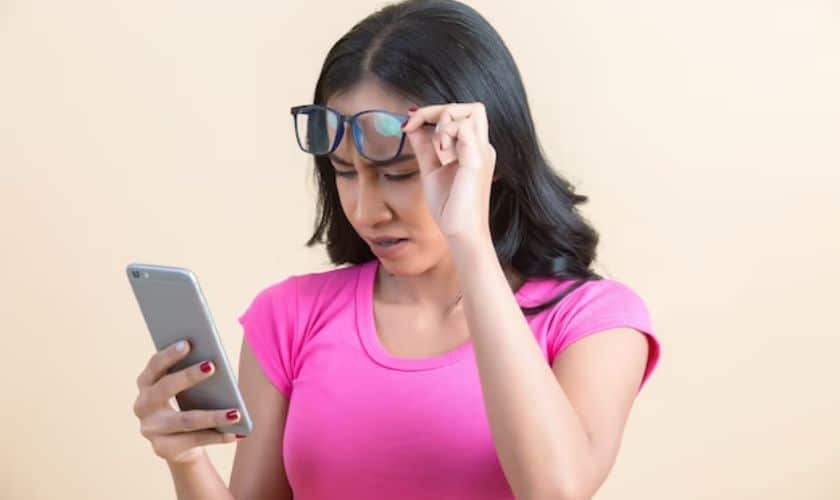
There’s a particular moment that many people in their early to mid-forties describe with striking consistency: they hold their phone a little farther away to read a text, squint at a restaurant menu in dim light, or find themselves tilting their head at the computer screen to find a comfortable focal point. These moments feel minor at first. Easy to attribute to tiredness, bad lighting, or a headache. But they’re often the earliest signals of presbyopia — and the sooner you recognize them, the better positioned you are to manage them.
Presbyopia is not a disease. It’s a natural, age-related change in how your eyes focus, and virtually everyone will develop it to some degree. According to the American Academy of Ophthalmology, presbyopia affects more than 128 million people in the United States, with onset typically beginning around age 40. The underlying cause is gradual stiffening of the crystalline lens inside the eye, which reduces its ability to flex and shift focus between near and far distances — a function called accommodation.
For people who spend long hours outdoors, at their desks, or on mobile devices, the early signs of presbyopia can feel especially disruptive. Progressive lenses for clear vision remain one of the most widely used and clinically effective corrections for the condition — but before you get to solutions, knowing what you’re looking for helps you act at the right time.
Why the Earliest Signs of Presbyopia Are So Easy to Dismiss
Presbyopia develops gradually, which is both a clinical reality and the main reason people delay addressing it. The lens stiffens slowly over several years, and your brain is surprisingly good at compensating for subtle changes in focus. You adjust your posture, your screen brightness, and your reading distance without consciously registering that something has shifted in how your eyes work.
This adaptation is helpful in the short term, but it can delay a diagnosis by months or even years. By the time many people seek an eye exam for presbyopia, they’ve been managing symptoms with workarounds — larger phone font, brighter reading lights, holding books at arm’s length — long enough that the condition has progressed further than it needed to before being addressed.
The Earliest Warning Signs: What to Watch For
Difficulty Reading Small Print at a Normal Distance
This is the hallmark early sign and the one most people notice first. The fine print on medicine bottles, nutritional labels, or the footnotes of a document that used to be easy to read starts requiring a second look — and then a third. At first, it might only happen when the lighting is poor. Over weeks and months, it starts happening even in good light. If you’re consistently moving reading material farther from your face to bring it into focus, that’s worth noting.
Eye Fatigue That Arrives Faster Than It Used To
Reading, working on a laptop, or doing detail-oriented tasks like crafting or cooking from a recipe card all demand sustained near focus. The eyes have to work harder to maintain that focus with presbyopia, and they tire faster. If you notice a burning sensation, heaviness behind the eyes, or a desire to take frequent breaks from reading that’s noticeably worse than before, presbyopia may be contributing.
Headaches That Follow Reading or Screen Time
Frontal headaches, around the forehead or behind the eyes, that appear after working in a dimly-lit area, are a recognized early symptom of presbyopia. The ciliary muscles inside the eye, which control the lens’s shape during accommodation, are constantly contracting to compensate for the stiffening lens. That muscular overwork can create tension that radiates into a headache. If you’re reaching for ibuprofen more often on days with heavy reading, it’s worth connecting those dots.
A Lag When Switching Between Near and Far Focus
Healthy accommodation happens in fractions of a second. You glance at your phone, then look up at the TV, and both are sharp almost immediately. With early presbyopia, there’s often a slight delay—a moment of blur when your eyes have to shift the focal plane. This transient blurring when switching between distances is easy to overlook, but it’s a clinically meaningful sign that accommodation is becoming less agile.
Needing Significantly More Light to Read Comfortably
Presbyopia doesn’t reduce the amount of light entering your eye, but it changes how effectively you can use that light for near tasks. Reading in dim light — a restaurant, a bedroom at night, a poorly lit office — starts feeling genuinely difficult rather than just slightly inconvenient. Many people with early presbyopia notice they’re instinctively moving to better-lit areas to read or switching on additional lamps. That behavioral shift is telling.
Squinting Has Become a Reflex
Squinting constricts the pupil and reduces the cone of light entering the eye, which temporarily sharpens focus by increasing depth of field — it’s a physics trick the eye uses instinctively. If you catch yourself squinting at your phone, a menu, a price tag, or a medication label regularly, it’s a reliable indicator that your eyes are compensating for something. That something is often early presbyopia.
What Happens If You Keep Ignoring These Signs?
Presbyopia doesn’t reverse or stabilize on its own — it progresses. The lens continues to lose elasticity through your forties and into your mid-fifties, when most people reach a plateau. Avoiding correction during this window doesn’t protect your vision; it just means you’ll spend more time straining, squinting, and managing avoidable discomfort. It also means your first prescription may need to account for more correction than an earlier intervention would have required.
There’s also a quality-of-life dimension worth acknowledging. Difficulty reading affects how you work, how you relax, and how you engage with everyday tasks. Scottsdale’s active outdoor lifestyle — hiking in the McDowell Sonoran Preserve, mornings on the golf course, evenings reading on a patio — all involve situations where clear near vision matters. Waiting isn’t neutral.
How Presbyopia Is Corrected: What Your Options Look Like
Several correction strategies exist for presbyopia, and the right one depends on your lifestyle, your baseline vision prescription (if any), and personal preference.
Reading glasses — the simplest and most widely available option — correct near vision but require removal to see at a distance. They’re practical for someone who only occasionally needs close focus, but less so for people who constantly shift between near and far tasks throughout the day.
Bifocals provide two distinct focal zones in one lens: distance at the top, near at the bottom, with a visible line between them. They work but don’t address intermediate vision — the middle distance used for computers, dashboards, and grocery shelves.
Progressive lenses for clear vision address all three focal zones — near, intermediate, and distance — in a single lens with no visible lines. The optical power gradually changes from top to bottom, providing wearers with a continuous range of clear vision rather than two or three fixed focal points. For people whose daily lives involve frequent transitions between far, mid-range, and close-up, progressive lenses remain the most versatile correction available. Modern progressive lens designs have also improved significantly in terms of peripheral distortion, which earlier versions were sometimes criticized for.
Contact lens options for presbyopia include multifocal contacts and monovision fitting. Surgical options like corneal inlays and refractive lens exchange are available for qualifying candidates who prefer a non-spectacle correction. Our eye care specialist can walk you through which approaches are realistic for your specific case.
Your Near Vision Is Worth Acting On
Presbyopia moves slowly enough that it’s easy to put off addressing it indefinitely. But every month of squinting, straining, and working around blurry near vision is a month of unnecessary effort. The fix is straightforward — and it starts with one appointment.
Schedule a comprehensive eye exam at Scottsdale Eyeology today. Come in with your symptoms, your questions, and a clear sense of what your daily visual demands look like — and leave with a plan that actually fits your life.
People Also Ask
Can presbyopia develop before age 40?
It’s uncommon but not impossible. Premature presbyopia — onset before 40 — can occur and is more likely in people who already have hyperopia (farsightedness), since their lenses are already working harder to maintain near focus. Certain medications, medical conditions, and nutritional deficiencies have also been associated with earlier onset. If you’re in your thirties and noticing symptoms, it’s worth getting evaluated rather than assuming it’s too soon.
Will wearing reading glasses make my presbyopia worse faster?
This is a common concern, and the answer is no. Wearing appropriate correction for presbyopia does not accelerate the progression of the condition. The lens stiffening that causes presbyopia is a biological process that continues at its own rate regardless of whether you use glasses. Not wearing correction and straining instead don’t slow presbyopia — they just add discomfort without changing the underlying trajectory.
I already wear distance glasses. How does presbyopia change my prescription?
If you already have a distance prescription for myopia (nearsightedness), presbyopia adds a near-vision correction component called an “add” power to your prescription. This is measured during your exam and indicates the additional lens power needed to restore comfortable near focus. Progressive lenses or bifocals are then made to incorporate both your distance and near corrections in one lens. Your prescription will need periodic updating as presbyopia progresses.
How long does it take to adjust to progressive lenses?
Most first-time progressive lens wearers adapt within one to two weeks, though the range varies. During the adjustment period, peripheral areas of the lenses may initially cause a slight distortion or a “swimming” sensation when moving your head. This usually resolves as your visual system learns to use different parts of the lens intuitively. Full-time wear during the adaptation period significantly speeds up the process compared to wearing progressives only occasionally. If significant discomfort or distortion persists beyond two to three weeks, contact your eye care provider — the prescription or lens design may need adjustment.
Can LASIK correct presbyopia?
Standard LASIK corrects distance refractive errors (myopia, hyperopia, astigmatism) but does not address the lens stiffening that causes presbyopia. Some providers offer a LASIK-based approach called monovision, where one eye is corrected for distance and the other for near, but this requires adaptation and isn’t suitable for everyone. A thorough candidacy evaluation is essential before pursuing any surgical route.